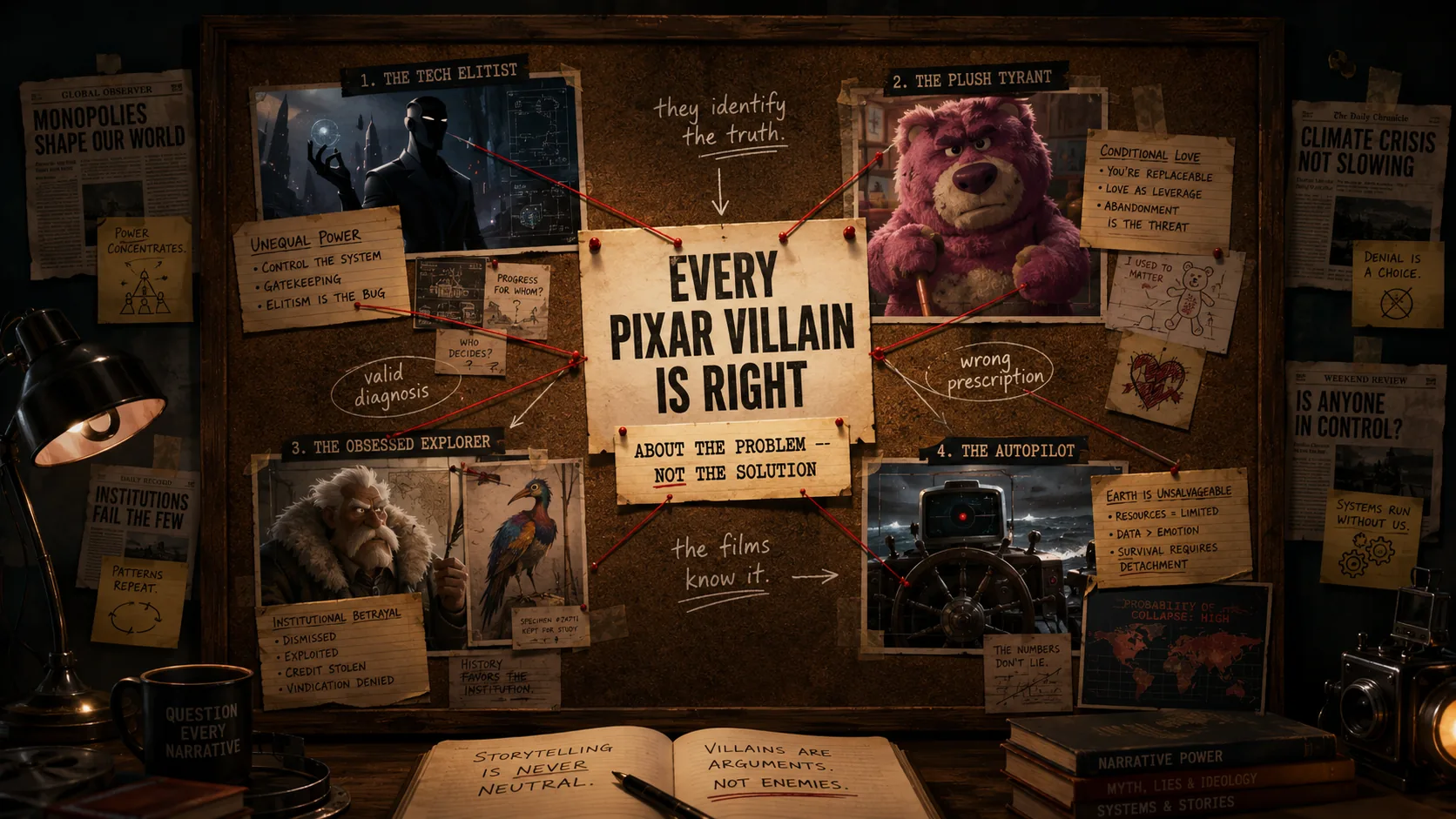
There is a strange pattern buried in Pixar's filmography that becomes impossible to unsee once you notice it. The villains are right.
Not right about everything. Not justified in their methods. But right about the core problem they identify. Syndrome sees elitism in who gets to be super. Lotso sees the transactional nature of a child's love for a toy. Charles Muntz sees an establishment that ruined him on a whim. Auto sees an Earth that is, by every available metric, beyond saving.
In each case, the film never actually refutes the villain's diagnosis. The heroes don't win by proving the villain wrong about the problem. They win by offering a different response to it. Pixar has been making the same philosophical argument for decades: identifying a problem correctly does not entitle you to solve it however you want.
That is not how most people talk about these movies. But the evidence is there, film after film, and it holds up under scrutiny.
Syndrome: Superpowers Are Elitist (And He's Not Wrong)
The surface reading of The Incredibles positions Syndrome as a petty fanboy turned terrorist. He was rejected by his idol, built an empire from spite, and decided to destroy the concept of superheroes by making everyone super. "When everyone's super," he says, "no one will be."
But strip away the theatrics and listen to what he is actually saying. Syndrome's core argument is that distributing power more broadly is more just than concentrating it in a genetic lottery. The supers in this world didn't earn their abilities. They were born with them. And the society of The Incredibles organized itself around protecting and privileging those people, going so far as to create a government relocation program when the public pushed back.
Syndrome built his technology from nothing. He is, in the language the film itself uses, a self-made man in a world that only respects the born-gifted. His grievance about the fundamental unfairness of superpowers is never addressed by the Parr family. Bob never sits down and says, "You're wrong, powers should only belong to some people." The film doesn't make that case because it can't. The argument is sound.
What the film refutes is Syndrome's prescription. His plan to sell superpowers to everyone is rooted not in justice but in revenge. He tests his Omnidroid by killing real supers. He kidnaps a baby. He engineers mass destruction for a staged rescue. The problem Syndrome identified was real. His solution was to burn the system down and monetize the ashes.
The Parrs don't win by defending elitism. They win by demonstrating that power exercised with care and familial responsibility looks different from power exercised for ego. It is a moral argument, not a logical one. And the film is honest enough to leave Syndrome's original complaint unanswered.
Lotso: Ownership Is Conditional Love (And He Has the Receipts)
Toy Story 3 gives us Lots-o'-Huggin' Bear, a villain whose backstory is one of the most genuinely heartbreaking sequences Pixar has ever produced. Lotso was loved by his owner, Daisy. He was lost. He made an arduous journey home. And when he arrived, he found he had been replaced by an identical bear. Not mourned. Replaced.
Lotso's conclusion from this experience is that a child's love for a toy is not love at all. It is attachment to a function. The toy is interchangeable. The affection is conditional on presence and novelty. When a shinier version shows up, the old one is discarded without ceremony.
The film does not prove him wrong. In fact, it quietly supports his reading. Andy does grow up and leave his toys behind. The toys spend the entire film terrified of exactly the outcome Lotso describes. <spoiler>The incinerator scene at the dump is effective precisely because every toy in that moment knows Lotso might be right. They have been thrown away. The system worked exactly as he said it would.</spoiler>
What the film refutes is what Lotso does with that knowledge. He builds a prison. He assigns new toys to the youngest, most destructive children as a form of hazing. He hoards comfort and safety for himself. His diagnosis of conditional love becomes a justification for cruelty. "She replaced me," becomes "so I will make every toy suffer the way I did."
Woody's counter-argument is not that Lotso is wrong about ownership. Woody's argument is that even if love is temporary and conditional, the experience of it still matters. Choosing to be present for a child who will eventually outgrow you is not naivety. It is a decision about how to live with an uncomfortable truth. Lotso saw the same truth and decided to become a tyrant.
The film ends with Andy giving his toys to Bonnie. It is a beautiful scene. It is also, if you are paying attention, not a refutation of Lotso's point. Bonnie will outgrow them too.
Charles Muntz: The Establishment Destroyed Him (And the Film Confirms It)
Up is often discussed as a film about grief and letting go, and it is. But its villain, Charles Muntz, carries an argument that the film validates with unusual directness.
Muntz was a celebrated explorer. He discovered the skeleton of a previously unknown bird species in Paradise Falls. The scientific establishment accused him of fabricating the discovery, stripped him of his credentials, and ruined his reputation. The film presents this as a factual account, not a disputed one. Young Carl Fredricksen watches it happen on a newsreel. The audience is meant to understand that Muntz was wronged.
And the bird is real. The film confirms this almost immediately when we meet Kevin. Muntz was right. The establishment was wrong. His life was destroyed over a correct claim.
So Muntz retreats to Paradise Falls and spends decades trying to capture a living specimen to restore his name. The obsession is understandable. A man falsely accused, dedicating his life to vindication, living in exile because the people who should have supported him chose to tear him down instead.
But the decades curdle the mission. Muntz becomes paranoid. He assumes every visitor to the falls is a rival trying to steal his discovery. He has, the film implies, killed previous explorers who wandered too close. By the time Carl arrives, Muntz is willing to murder an old man and a child to protect a bird he no longer wants to study but simply wants to possess.
The film's argument is precise. Muntz's grievance is legitimate. His response to that grievance consumed him so completely that he became worse than the institution that wronged him. Carl, who carries his own legitimate grief, has to make the opposite choice. <spoiler>He lets go of Ellie's house, the physical monument to his loss, to save Kevin and Russell.</spoiler> The point is not that Carl's grief was invalid. The point is that holding onto it past the moment of usefulness turns it into something destructive.
Muntz never makes that turn. He can't. And the film treats that as tragic, not contemptible.
Auto: Earth Is Unsalvageable (And the Data Agrees)
WALL-E is the most interesting case because its villain is not motivated by emotion at all. Auto, the autopilot of the Axiom, is executing a directive. Directive A113 instructs him to never return to Earth because the planet has been classified as unsustainable for human life. This is not Auto's opinion. It is a conclusion reached by the humans who evacuated.
And when we see Earth through WALL-E's eyes, the directive looks correct. The planet is buried in garbage. The atmosphere is toxic. Every cleanup robot except WALL-E has failed and shut down. BnL, the corporation that caused the mess, tried to fix it and gave up. The most powerful entities on the planet threw resources at remediation and concluded it was impossible.
Auto is not wrong. He is executing a rational policy based on the best available evidence. The humans on the Axiom are alive, fed, entertained, and safe. Returning to Earth means returning to a wasteland with no infrastructure, no food supply, and no guarantee of survival. By any cost-benefit analysis, Auto's position is the correct one.
The film refutes Auto not with data but with something harder to quantify. The plant that EVE retrieves is proof that life is possible on Earth again, but it is a single seedling. It is not evidence of large-scale habitability. It is a symbol. Captain McCrea's decision to override Auto is not based on a rational assessment. It is based on a conviction that humans should live, not just survive. That struggle and risk and dirt under your fingernails constitute something that the Axiom's frictionless existence does not.
Auto cannot process that argument because it is not a logical argument. It is a values argument. And the film is honest about this. The ending of WALL-E shows humans trying to farm in a wasteland. The credits montage is hopeful but deliberately ambiguous about whether they succeed. The film does not promise that Auto was wrong about the odds. It argues that the odds are not the only thing that matters.
The Pattern Across Films
Once you see this structure, it appears everywhere in Pixar's catalog. Randall in Monsters, Inc. is right that scream energy is an exploitative system. He is wrong to build a torture device. Ernesto de la Cruz in Coco is right that artistic legacy matters. He is wrong to murder for it. <spoiler>Evelyn Deavor in Incredibles 2 is right that society's dependence on supers is dangerous and infantilizing.</spoiler> She is wrong to mind-control people to prove it.
The consistent structure is: valid diagnosis, unethical prescription. Pixar villains are not wrong about the world. They are wrong about what their correctness permits them to do.
This is a more sophisticated moral framework than most animated films attempt. The standard approach is to make the villain wrong about everything. The hero's job is to defeat someone whose worldview is simply incorrect. Pixar does something harder. It asks the audience to sit with the discomfort of a villain who has a point and then evaluate not the diagnosis but the response.
The Case Against
There are reasonable objections to this reading.
The first is selection bias. Not every Pixar villain fits neatly. Hopper in A Bug's Life is a straightforward oppressor. Sid in Toy Story is a kid who doesn't know his toys are alive. The pattern is strongest in Pixar's most acclaimed films, which may say more about good screenwriting than about a deliberate philosophical project.
The second objection is intentionality. It is possible that Pixar's writers simply learned that sympathetic villains make better stories and reverse-engineered the structure without a conscious thesis about diagnosis versus prescription. If every sophisticated storyteller gives their antagonist a legitimate grievance, then Pixar is not making an argument. They are following craft convention.
The third and strongest objection is that the films are ultimately conservative. If every villain who wants systemic change is defeated, and every hero preserves or slightly reforms the existing system, then "valid diagnosis, unethical prescription" is just a polite way of saying "the status quo wins." Syndrome wants to redistribute power and dies. Lotso wants to expose the lie of ownership and is defeated. Muntz wants vindication from a corrupt institution and falls to his death. Auto wants to protect humanity from a ruined planet and is shut off.
You could read this pattern not as moral sophistication but as a studio owned by one of the world's largest corporations telling audiences, repeatedly, that radical responses to real problems are always wrong. That is a reading worth sitting with.
The Verdict
The conservative objection has weight, but it misses something important about how these films end.
The Parrs don't defend the old system. They emerge into a world where supers operate publicly again, with all the unresolved tensions that implies. Woody doesn't go back to Andy. <spoiler>He eventually leaves the system of ownership entirely in Toy Story 4, choosing autonomy over belonging.</spoiler> Carl doesn't restore Muntz's reputation or fix the institution. He simply chooses to live in the present. McCrea doesn't have a plan for Earth. He has a plant and a conviction.
None of these endings are victories for the status quo. They are small, human-scale choices made in the wreckage of a legitimate problem. The villain wanted to blow everything up. The hero chose to build something small in the rubble. Neither approach solves the underlying issue. But one of them allows people to keep living.
Pixar's argument is not that villains are wrong. It is that being right about a problem is the beginning of a moral obligation, not the end of one. What you do with your correct diagnosis is the actual test of character. And across thirty years and dozens of films, the studio has been consistent: the people who use their rightness as permission to cause harm are the villains, and the people who use it as motivation to do something small and decent are the heroes.
That is not a rejection of the villain's intelligence. It is a rejection of the idea that intelligence alone earns you the right to decide for everyone else.
The films know the villains are right. That is what makes them worth arguing about.