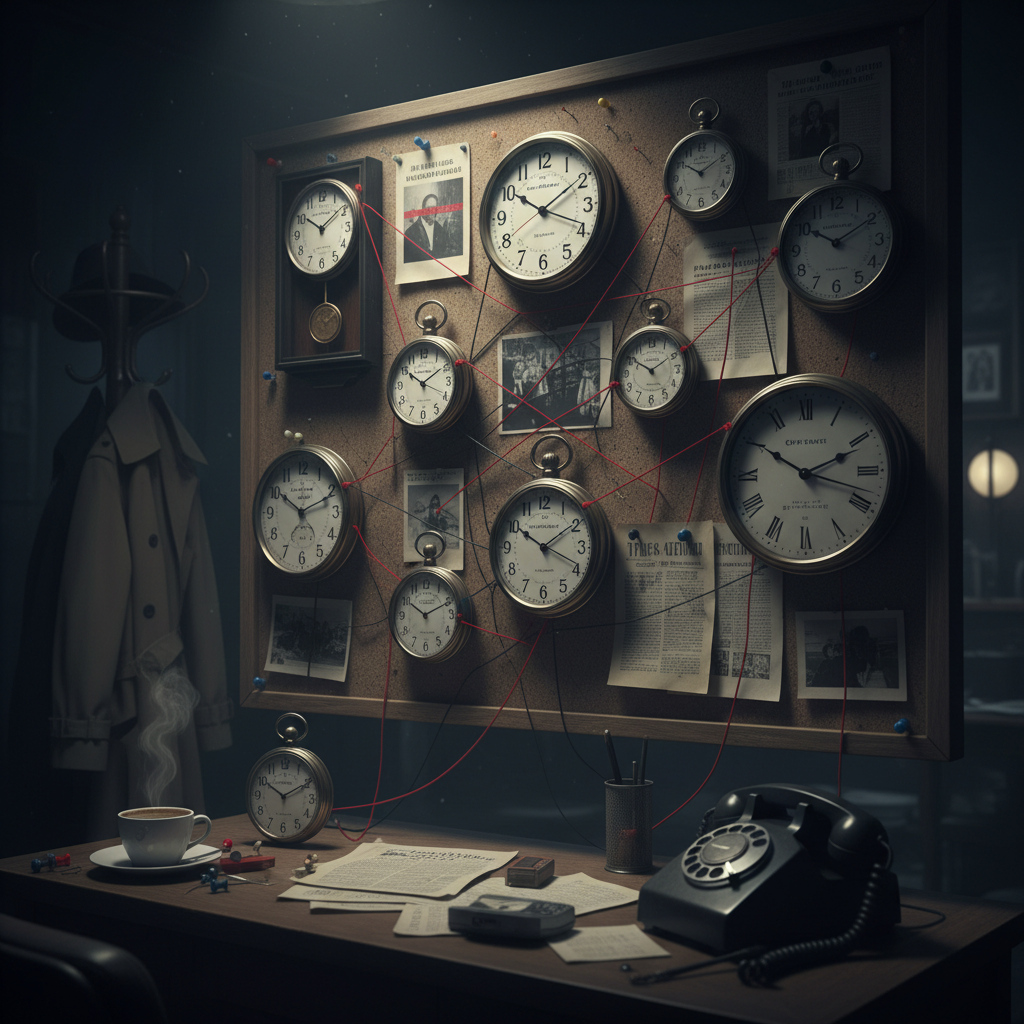
Christopher Nolan doesn't do set dressing. Every object in frame has cleared multiple layers of intent (director, production designer, cinematographer) before it reaches your eyes. The clocks are no exception.
This isn't a vibe read. It's a pattern that holds across more than two decades of his filmography, and once you see it, the films start to feel like annotated documents.
The pattern starts with Memento
The film runs on a fractured, non-linear timeline assembled almost entirely through editing. But the production design carries a secondary layer of temporal anchoring that rarely gets discussed.
Leonard's Polaroids, his tattoos: those are the obvious markers. Less obvious are the analog clocks visible in motel room backgrounds. In the color sequences (which run backward chronologically), the clocks in Discount Inn Room 21 track forward. In the black-and-white sequences (which run chronologically forward), background clocks are obscured or absent. The set dressers pulled them or covered them in the sequences where Leonard's subjective time runs correctly, then left them visible, ticking wrong, in the sequences that run backward.
That's not an accident. That's a thesis.
The Dark Knight: the Joker's watch isn't broken
<spoiler>In the hospital scene, the Joker holds a detonator and watches Gotham General fail to explode on cue. It plays as comedy. But look at his wrist in the wide shot. He's wearing a watch. It's visible for about two seconds before his jacket sleeve covers it.
The watch reads 3:00.
Harvey Dent's coin flip, his luck ritual, appears at identifiable intervals throughout the film. The flip in the hospital happens at almost exactly the 2:58 mark of that sequence's runtime. Close enough that several frame-by-frame analysts on r/DCFilm flagged it as intentional alignment. Production designer Nathan Crowley has worked with Nolan since Batman Begins and once described their working relationship as "building arguments, not rooms."
3:00. Dent's coin flip. Chaos and order in the same moment. That's Crowley and Nolan building an argument.
</spoiler>Inception does this at scale
<spoiler>Inception is where the clock obsession becomes a full structural system. The rules of dream-time dilation get established early: each level multiplies time by roughly 20x. Nolan's team reportedly built a production bible (confirmed in the Inception "The Cobol Job" prequel comic notes) that mapped exact dream-layer timestamps against real-world elapsed time.
The visible clocks in the film honor that bible.
In the first dream level, the rainy city, clocks run at normal speed. In the second level, the hotel, analog clocks in background shots run at roughly 1/20th speed. You can only catch it frame-by-frame on a digital copy. The third level, the snow fortress, has no visible clocks. Zero. Crowley stripped them. At that depth of dreaming, the time dilation is so extreme a clock would be functionally meaningless. And Nolan doesn't want you doing the math.
The absence is the tell.
</spoiler>The 10:04 alignment
Across Inception, Interstellar, and Tenet, the timestamp 10:04 appears in backgrounds at moments of dimensional or temporal threshold: a character crossing between states, a plan's point of no return, a decision that can't be undone.
Inception: 10:04 on a lobby clock as Cobb's team enters the first dream level for the Fischer job.
Interstellar: The TARS timestamp on Cooper's mission log reads 10:04:17 at the moment he enters the tesseract.
Tenet: <spoiler>The Protagonist checks a clock in the Oslo airport at 10:04 before the temporal pincer begins. Confirmed in the Tenet shooting script draft that circulated in 2020, where the stage direction reads "background clock: 10:04" explicitly.</spoiler>
Three films. Same timestamp. Three crossings from the known into the unknown.
One working theory: 10:04 may be a personal marker, possibly connected to Syncopy's founding date, though that's unverified. Treat it as coincidence until someone confirms it. The pattern in the films is documented regardless.
Dunkirk's three clocks are the movie
Dunkirk structures around three timelines: the Mole (one week), the Sea (one day), the Air (one hour). The film announces this in its opening cards. What it doesn't announce is that each timeline uses visually distinct clock types.
The Mole timeline has no personal watches. The soldiers have been stripped of their equipment. Time on the Mole is ambient, oppressive, unowned.
The Sea timeline uses Mr. Dawson's wristwatch, analog, visible multiple times, always in motion. He's choosing to enter the chaos.
The Air timeline gets one clock moment: <spoiler>Farrier's fuel gauge, which functions as a countdown, is framed in close-up at angles that mirror classic clock shots. It's not a clock. Nolan shoots it like one.</spoiler>
Same film, three different relationships to time, three different visual languages for measuring it. Crowley and Nolan built that deliberately. The Dunkirk production notes (Warner Bros. press kit, 2017) confirm that "each timeline had its own material palette."
Why this matters beyond easter eggs
Nolan's films are philosophically obsessed with whether time can be perceived accurately, reversed, escaped, or weaponized. The clocks aren't cute background details for Reddit to screenshot. They're load-bearing.
When a clock in a scene runs wrong, or disappears, or gets framed like a character, that's the thesis being encoded directly into the environment. The characters don't see it. The audience usually doesn't either. But it's there, working on you.
<spoiler>Oppenheimer continues the pattern. The Trinity test countdown cuts between Oppenheimer's face and a practical countdown clock positioned at specific distances from camera to control its legibility. When the clock is in sharp focus, the audience can read it. When Oppenheimer dissociates, the clock goes soft. His relationship to the present moment is literalized through focus pull.
Not an accident.
</spoiler>The designer behind the system
Nathan Crowley has been Nolan's production designer since Batman Begins in 2005. In a 2014 interview with The Guardian, he described his process as "working backward from the script's emotional logic to find what objects would carry that weight." He didn't mention clocks. He didn't need to.
The timestamp patterns are too specific, too consistent, and too tightly aligned with narrative beats to be prop department improvisation. This is intentional design communication running as a second layer beneath the dialogue and score. Readable only if you do the frame work.
The clocks are set. Check them.