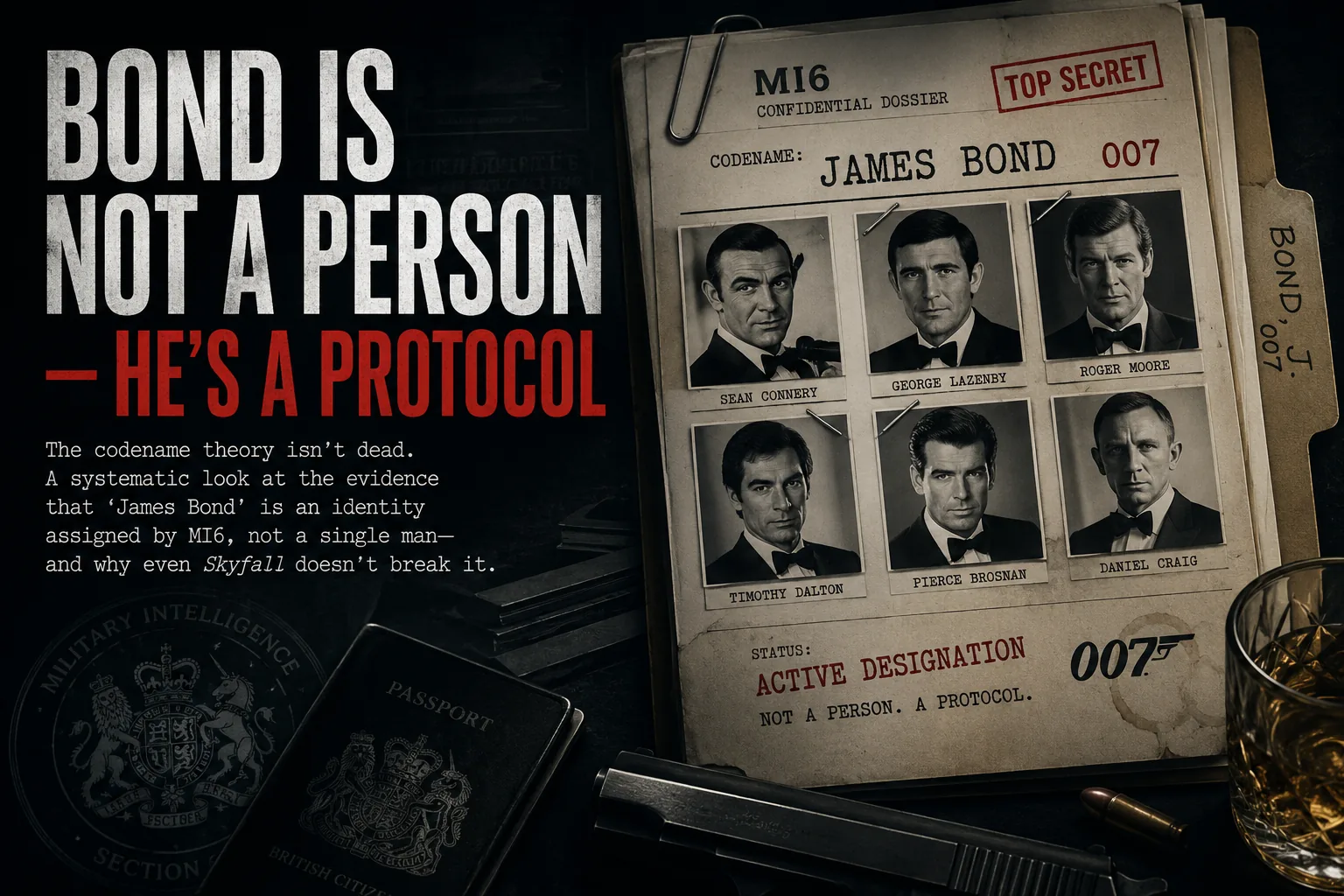
Six actors have played James Bond across twenty-seven films. Each one looks different, sounds different, moves through the world differently. Sean Connery's Bond is a predatory charmer. Roger Moore's is a quip machine in a safari jacket. Daniel Craig's is a blunt instrument who bleeds. The franchise treats this as a production reality you're not supposed to think about. You hire a new actor, you keep going, the audience adjusts.
But here's the problem: the films don't behave like a simple recast. They behave like a relay. Details shift between actors in ways that go beyond cosmetic. Relationships reset. Backstories contradict. The world around Bond ages, but Bond himself keeps rebooting. If you watch the series looking for continuity, you won't find a single man living an impossibly long life. You'll find a pattern -- one that looks a lot like an institutional protocol.
The theory: "James Bond" is not a person. It's an MI6 designation. A cover identity assigned to the agent who holds the 007 number. The name, the habits, the martini order, the Aston Martin -- all part of a manufactured legend designed to make enemies believe they're facing the same unkillable operative, decade after decade.
The Reset Problem
Every Bond transition introduces a clean break that the films never explain.
When George Lazenby takes over in On Her Majesty's Secret Service (1969), the film opens with him saving a woman on a beach. She drives away. He turns to the camera and says, "This never happened to the other fella." That line is usually read as a meta-joke, a wink at the audience about the casting change. But inside the world of the film, it does something else entirely. It acknowledges that there was another fella. That this Bond is not the same man who came before.
When Roger Moore arrives in Live and Let Die (1973), M visits him at home, and Bond is living in a completely different flat with a completely different aesthetic. No explanation. When Timothy Dalton steps in, the tone shifts to grim realism. When Pierce Brosnan takes over, it snaps back to glamour. Each transition isn't just a new face. It's a new personality, a new set of instincts, a new relationship to violence and women and authority.
If Bond were one continuous character, these shifts would be jarring mistakes. But if Bond is a rotating designation, they become features. Each new agent brings his own temperament to the role, the way different officers bring different command styles to the same rank.
Institutional Fingerprints
Look at what stays constant across every Bond, regardless of actor: the number (007), the superior (M), the quartermaster (Q), the secretary (Moneypenny), the drink order, the introduction line ("Bond. James Bond."), and the access to an almost unlimited operational budget. These aren't personality traits. They're institutional artifacts -- the fixed elements of a cover identity that MI6 maintains across deployments.
The "Bond package" functions like a legend in intelligence tradecraft. A legend is a fabricated identity with enough depth and history to survive scrutiny. Real intelligence agencies build legends that multiple officers can step into. The name, the backstory, the social patterns are all pre-built. The officer just has to inhabit them convincingly.
Consider how Bond interacts with recurring characters. Moneypenny flirts with every Bond. Not because she's attracted to the same man across forty years, but because flirting with 007 is part of the office ritual -- a shared bit of theater that reinforces the legend even inside MI6. M briefs every Bond with the same mixture of exasperation and trust. Not because one relationship persists, but because M's role in the protocol requires that dynamic. The relationship is with the designation, not the man.
Q is perhaps the most telling. The quartermaster equips each Bond with the same deadpan irritation, the same warnings about returning equipment intact. Q doesn't adapt to each Bond's personality. He relates to the role. When Desmond Llewelyn's Q hands gadgets to Connery, Moore, Dalton, and Brosnan, his demeanor barely shifts. That consistency makes more sense if Q is interfacing with a position, not a person.
The Continuity Gaps Nobody Mentions
If Bond is one man, the timeline collapses.
Connery's Bond is active in the early 1960s. Brosnan's Bond is active in the late 1990s. That's a minimum thirty-five-year career for a field agent in a job with a life expectancy measured in missions, not decades. Moore's Bond alone spans twelve years of films (1973-1985). Add Connery's era before him and Dalton's after, and you need a single man who's been doing active wetwork for nearly three decades without slowing down.
The films never address Bond's age. They don't show him getting older. They don't reference his long service record across eras. Each Bond operates as if he's in his prime, which is exactly what you'd expect if each Bond is in his prime -- because each one is a different agent.
There's also the matter of dead wives. <spoiler>In On Her Majesty's Secret Service, Bond marries Tracy di Vicenzo. She's murdered by Blofeld in the final scene.</spoiler> This is referenced in later films, but inconsistently. Moore's Bond visits Tracy's grave in For Your Eyes Only, which supporters of the single-Bond reading point to as proof of continuity. But within the codename framework, that visit makes even more sense. The current 007 maintaining the previous 007's cover -- visiting "his" wife's grave -- is exactly how you'd preserve a legend. If enemies are watching, they see Bond mourning his wife. The fiction holds.
Meanwhile, Brosnan's Bond and Craig's Bond show no meaningful connection to Tracy at all. If this were one man's life, the defining trauma of his wife's murder would echo forward. It doesn't. It attaches to a specific era and then fades, the way institutional memory does when personnel rotate.
The Villain Recognition Problem
Here's where the theory gets its strongest traction: villains who should recognize Bond don't.
Blofeld is the centerpiece. Bond and Blofeld encounter each other face-to-face in You Only Live Twice (Connery). In the very next film, On Her Majesty's Secret Service (Lazenby), Blofeld doesn't recognize Bond. The usual explanation is that it's a production oversight, or that Lazenby's Bond is wearing a disguise during their early interactions. But the disguise is thin at best, and Blofeld is supposed to be a criminal genius running a global terror network. He can't recognize the agent who infiltrated his volcano base one mission ago?
Unless it's not the same agent.
If the 007 designation passed to a new operative between films, Blofeld's failure to recognize "Bond" isn't a plot hole. It's accurate. He's meeting a different person. The name is the same. The face isn't.
Jaws presents a similar case. The henchman appears in both The Spy Who Loved Me and Moonraker, both Moore films, so continuity holds there. But no recurring villain ever remarks on Bond's changing appearance across actors. In a franchise that loves callbacks and recurring antagonists, that silence is telling.
The same logic applies to SPECTRE as an organization. This is a global criminal network with extensive intelligence capabilities. They maintain dossiers, run surveillance operations, and track enemy agents across continents. If Bond were one continuous person, SPECTRE would have his biometrics, his gait analysis, his dental records. They would know exactly who they're dealing with every time he appeared. The fact that Bond can infiltrate SPECTRE operations across eras without being immediately flagged suggests that the face behind the name keeps changing -- and that SPECTRE's "Bond file" is perpetually out of date.
Even Felix Leiter, Bond's CIA counterpart, has been played by multiple actors across the franchise. The films never explain this either. Within the codename framework, the explanation writes itself: Leiter might be the CIA's version of the same protocol. Two allied agencies, each maintaining a persistent cover identity for their top liaison officer. Bond and Leiter aren't old friends. They're two designations that have been instructed to cooperate.
The Craft of the Legend
Intelligence agencies have real precedent for this kind of identity management. The CIA, MI6, and Mossad all use cover identities that can be transferred between officers. A case officer working an asset in one country might be "replaced" by another officer using the same cover name and legend, allowing the relationship with the asset to continue without exposing the agency's internal structure.
The Bond Protocol, as the theory frames it, is this practice scaled up to mythic proportions. MI6 doesn't just assign a cover name. They assign a persona -- complete with tastes (Vesper martini, shaken), habits (gambling, womanizing), style markers (the suit, the car), and a signature introduction. The persona is the weapon. Enemies who hear "Bond, James Bond" are meant to feel the weight of every previous encounter with that name. It's psychological warfare through continuity of brand.
This also explains the consistency of Bond's competence profile. Every 007 is an expert marksman, driver, fighter, and seducer. Not because one man masters all these skills across a lifetime, but because MI6 selects for them. The Bond Protocol requires agents who can plausibly inhabit the legend. You don't get the 007 designation unless you already fit the mold.
Think about it from a strategic perspective. If you're running an intelligence agency, a persistent identity is an extraordinary asset. Every successful mission attributed to "James Bond" adds to the legend's weight. Enemies who survive encounters carry stories back to their networks. Over time, the name itself becomes a deterrent. You don't need the same agent to maintain that effect. You need the same name. The reputation compounds regardless of who's wearing it. MI6 isn't in the business of building celebrity agents. They're in the business of building useful fictions. And "James Bond" might be their most useful fiction of all.
The Case Against: Skyfall and the Family Estate
The strongest objection to the codename theory comes from Skyfall (2012).
<spoiler>In the third act, Bond takes M to his childhood home in Scotland -- the Skyfall estate. A groundskeeper, Kincade, recognizes him. The family name on the estate is "Bond." There's a chapel with Bond family graves. The film presents "James Bond" as the character's birth name, not a cover identity.</spoiler>
This is the moment most people declare the codename theory dead. And on the surface, it does serious damage. If "Bond" is his real surname, the entire framework seems to collapse.
But look closer.
First: the Craig era functions as a reboot. Casino Royale (2006) is explicitly an origin story. It shows Bond earning his 00 status. The continuity with previous Bond eras is severed by design. Craig's Bond exists in a different timeline from Connery's, Moore's, Dalton's, and Brosnan's. So Skyfall proving that Craig's Bond is "really" named Bond doesn't disprove the theory for the earlier, interconnected films.
Second: even within the Craig timeline, the Skyfall evidence is less airtight than it appears. MI6 is an intelligence agency. Fabricating a backstory -- including a family estate, a groundskeeper who "remembers" the agent, and grave markers -- is well within their capability. If the Bond Protocol exists, the legend would need to be deep enough to survive exactly this kind of scrutiny. An enemy who investigates Bond's past needs to find a real place, real people, and real history. Skyfall Lodge could be a maintained legend site, and Kincade could be a long-term asset playing a role.
Is that a stretch? Yes. But it's not more of a stretch than a single man surviving the events of twenty-seven films across five decades.
Third: the Craig films actually reinforce the protocol concept in another way. <spoiler>At the end of Skyfall, Judi Dench's M dies and is replaced by Ralph Fiennes' Mallory, who takes the name "M." At the end of No Time to Die, Craig's Bond dies, and the 007 number is reassigned.</spoiler> The films show, on screen, that MI6 designations transfer between people. M is a title, not a name. Q is a title, not a name. If those designations rotate, the question isn't whether 007 could rotate too. It's why you'd assume it doesn't.
The Verdict
The codename theory doesn't require you to believe MI6 literally faked a Scottish estate. It requires you to notice what the films actually show: a name that persists while faces change, relationships that reset without explanation, villains who fail to recognize a man they've met before, and an agency that demonstrably rotates every other designation in its hierarchy.
The Craig era didn't kill this theory. It complicated it. And in complicating it, the filmmakers accidentally provided the strongest evidence yet -- by showing, in Skyfall and No Time to Die, that MI6 identities are designed to outlive the people who carry them.
Bond isn't a man with a long career. Bond is a protocol with a long history. The tuxedo fits differently every time because it's not the same body wearing it. But the tailoring is always sharp, the drink is always shaken, and the name always lands like a threat.
That's not continuity. That's institutional design.
The next time you watch a Bond film, pay attention to the seams. Watch how cleanly each new actor slots into the infrastructure without anyone in-universe blinking. Watch how M, Q, and Moneypenny treat the new face with practiced familiarity, not surprise. Watch how the world around Bond modernizes while Bond himself simply refreshes. These aren't the rhythms of a single extraordinary life. They're the rhythms of a system doing exactly what it was designed to do: replace the agent, preserve the legend, and keep the name alive.
Somewhere in the basement of MI6, there's probably a filing cabinet labeled "007 -- BOND PROTOCOL." And it contains everything the next agent needs to step into the role: the Walther PPK specs, the tailoring measurements template, the Aston Martin requisition form, and a note at the top that reads, in crisp institutional type: "Martini. Shaken, not stirred."