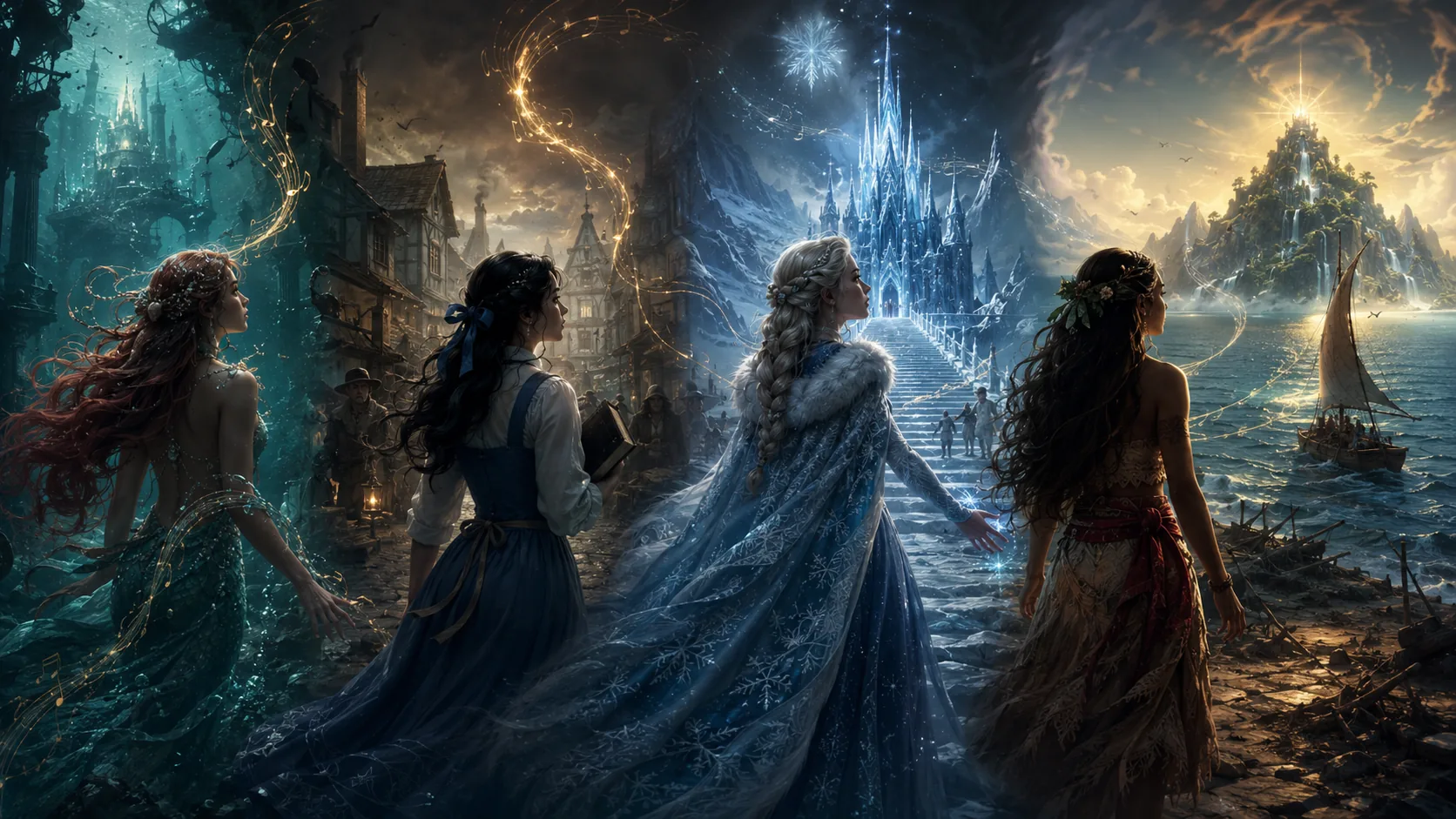
Every Disney princess leaves home. That's the surface reading, and it's not wrong. But it's incomplete in a way that matters.
Watch the films back to back, starting with The Little Mermaid and running through Moana, and a structural pattern emerges that goes beyond "empowerment arc" or "hero's journey." Each princess is placed in a situation where returning to her original community becomes impossible. The story frames this as growth. The soundtrack frames it as loss. And the new world she enters isn't freedom. It's a different power structure that needed her specific qualities all along.
This isn't about Disney being secretly evil. It's about a narrative engine that consistently produces the same output: displacement dressed as liberation.
The Setup: Making Home Impossible
Before the princess can be "recruited," her original world has to become uninhabitable. Disney accomplishes this with surgical precision, and the method barely changes across thirty years of films.
Ariel's ocean is a cage built by her father. King Triton doesn't just disapprove of the surface world. He destroys her grotto, her collection, her entire archive of identity. The film makes returning to the status quo emotionally impossible before Ariel ever signs Ursula's contract. Her home isn't taken from her by the villain. It's demolished by the person who claims to love her most.
Belle's village is intellectually dead. The opening number isn't charming. It's a diagnosis. "There must be more than this provincial life" isn't ambition. It's suffocation. The villagers think she's odd. Gaston thinks she's a prize. Her father is the only person who sees her, and the plot immediately removes him. Belle doesn't choose the Beast's castle. The film eliminates every alternative.
Elsa's Arendelle is built on a lie she was forced to maintain. Her parents' solution to her powers was concealment, isolation, and fear. The kingdom she inherits is one that would reject her if it knew who she was. When she flees, it's not rebellion. It's the collapse of an unsustainable arrangement. Arendelle didn't lose its queen. It never had one. It had a hostage performing a role.
Moana's island is dying. The coconuts are rotting. The fish are gone. Her father's prohibition against sailing isn't tradition. It's denial. Moana doesn't leave because she's restless. She leaves because staying means watching her community starve while obeying a rule that was never going to save them.
In every case, the original community is rendered either hostile, insufficient, or doomed. The princess doesn't reject home. Home rejects her first.
The Recruitment: Who Benefits?
Here's where the theory sharpens. If displacement were just a storytelling device, the princesses would find freedom on the other side. Instead, they find a new structure that slots them into a specific role.
Ariel Joins the Land Monarchy
Ariel trades her voice, her tail, and her entire species for membership in Prince Eric's world. The romantic framing obscures the mechanics: she literally signs a binding contract to gain entry into a different kingdom. She doesn't become free. She becomes a princess of a land she knows nothing about, married to a man she's spoken to for approximately one day.
The ocean kingdom loses a princess with a powerful voice. The land kingdom gains one. That's not liberation. That's a lateral transfer of assets.
Belle Becomes the Apparatus That Breaks the Curse
Belle's "rescue" is even more structurally revealing. The Beast needs a specific person: someone capable of love, isolated enough to have no alternatives, and intelligent enough to see past the exterior. The castle's enchanted staff spend the entire film engineering the conditions for Belle to fall in love. "Be Our Guest" isn't hospitality. It's an audition. They need her to perform a very specific emotional function, and everything in the castle is designed to facilitate that performance.
Belle doesn't choose the Beast. She's the only viable candidate the curse's logic permits. A woman who reads, who sees deeper, who has nowhere else to go. The enchantment didn't just trap the Beast. It created a recruitment profile.
Elsa Gets Reabsorbed on New Terms
Frozen is the most interesting case because it appears to subvert the pattern. Elsa leaves, builds her ice palace, sings the anthem of self-actualization. But she's dragged back. Anna's sacrifice doesn't free Elsa. It gives Arendelle a reason to accept her.
The kingdom gets a queen with supernatural power who is now emotionally bonded to her subjects through guilt and gratitude. That's a stronger ruler than the one who fled. Elsa returns not as herself, but as a version of herself that Arendelle can use. The ice powers that were a threat become a public works program. The skating rink in the courtyard isn't whimsy. It's a demonstration of allegiance.
<spoiler>Frozen II pushes this further. Elsa ultimately leaves Arendelle entirely to become the Fifth Spirit, a kind of elemental guardian. She's recruited again, this time by the enchanted forest itself. Anna takes the throne. The sisters are split across two power structures, each serving a role that the structure requires.</spoiler>
Moana Becomes the Wayfinder Her Island Needs
Moana's recruitment is the most transparent. Her island literally cannot survive without someone doing what she does. She's not following her heart. She's fulfilling a structural necessity. The ocean chose her. Te Fiti needs her. Her village needs a wayfinder to break the curse.
Every force in the story points Moana toward the same function. Her grandmother, the ocean, Maui, the mythology itself. She has the illusion of choice, but the narrative never presents a viable alternative. She either sails or everyone dies.
When she returns, she's not the chief's daughter who went on an adventure. She's the wayfinder, a role her community abandoned generations ago and now desperately needs restored. Moana fills a structural gap. The community gets to survive, but only by accepting the paradigm shift she represents.
The Soundtrack Knows
This is where the theory gets its sharpest evidence. Disney's songwriters are too good to miss what's happening in their own stories. And if you listen to the musical structure, the cost of displacement is acknowledged in ways the plot never addresses directly.
"Part of Your World" is not aspirational. It's a lament. Ariel sings it in her grotto, surrounded by human artifacts, and the melody carries yearning that borders on grief. She's not dreaming of adventure. She's mourning the fact that she doesn't belong where she is. The reprise, sung on the surface after she's already made her deal, shifts from longing to something closer to resignation. She's committed. The door behind her is closed.
"Belle" (the opening number) uses the townspeople as a Greek chorus diagnosing her isolation. They sing about her. She sings past them. The musical staging physically separates her from her community before the plot does. By the time the number ends, the audience has internalized that Belle cannot stay here. The song did the recruitment prep before the Beast ever entered the picture.
"Let It Go" is universally read as empowerment, but the musical key tells a different story. It's in Ab major, a key associated with grandeur but also with emotional remove. Elsa builds a palace of isolation and calls it freedom. The song's bridge admits what the chorus denies: she's alone, she's cold, and the "freedom" she's celebrating is actually a severing. Idina Menzel's vocal performance carries a tremor that the lyrics don't fully authorize. The body knows what the words won't say.
"How Far I'll Go" frames the ocean as a call Moana can't refuse. The melody pulls outward, but the lyrics keep circling back to obligation: her people, her role, the line between water and shore. It's not "I want adventure." It's "something is pulling me and I don't fully understand why, but I know I can't ignore it." That's not a call to freedom. That's a recruitment pitch dressed as wanderlust.
Even the reprises tell this story. Disney reprises tend to arrive at the moment of commitment, when the princess crosses the threshold. And in almost every case, the reprise is musically thinner than the original. Fewer instruments. A rawer vocal. The orchestration pulls back as if the score itself is acknowledging that something has been stripped away. Ariel's reprise is practically a cappella. Moana's reprise drops the percussion entirely. The lush arrangements return only once the princess has been fully absorbed into her new role. The score celebrates the destination but mourns the departure, and it does this so consistently across the Disney canon that it's hard to call it coincidence.
The Pattern Across Decades
The consistency is what makes this theory hard to dismiss. It's not one film making a particular narrative choice. It's a formula that Disney animation returns to across three decades:
- Establish the princess's original community as inadequate or hostile
- Create an impossible situation that forces departure
- Present a new power structure that needs exactly what the princess offers
- Frame the absorption into that structure as personal growth
- Let the music carry the emotional cost the plot won't acknowledge
Rapunzel in Tangled follows it precisely. Her tower is a prison maintained by a false mother. Mother Gothel doesn't just restrict Rapunzel. She constructs an entire worldview designed to make the outside feel lethal. The kingdom of Corona, meanwhile, has spent eighteen years launching lanterns into the sky. That's not hope. That's a kingdom-wide search protocol. They need their princess back because she's the rightful heir, and without her, the line of succession is broken. Rapunzel doesn't discover who she is. She discovers what she's needed for. Her magical hair, her bloodline, her capacity to heal: all of it serves the kingdom's requirements more than her own.
Tiana in The Princess and the Frog is arguably the most self-aware version. She explicitly wants independence, a restaurant, self-made success. She's the only Disney princess with a business plan. The film's resolution gives her the restaurant, but only after she's been transformed (literally into a frog and back), married into a royal line (even a broke one), and reoriented her ambition through the lens of partnership. She gets what she wanted, but the path required her to become what the narrative needed. Notice that Tiana's solo ambition is framed as incomplete until she accepts the romantic structure. Her father's dream was about community, the film tells her. Not just the restaurant. The recruitment is subtle, but it's there: individual drive gets folded into a partnership framework before it's allowed to succeed.
Even Mulan, who returns home, does so only after she's been absorbed into the imperial military structure, saved the emperor, and been offered a cabinet position. She turns it down, but the offer is the point. The system recognized her value and attempted recruitment. Her refusal is the exception that proves the pattern. Disney's live-action remake quietly removed the refusal. In that version, Mulan accepts a role in the emperor's guard. The pattern reasserted itself.
The Case Against
The obvious counterargument: this is just the hero's journey. Every protagonist leaves home, faces trials, and returns transformed. Joseph Campbell wrote this playbook decades before Ariel grew legs.
That's fair. But the hero's journey doesn't require the original community to be rendered specifically inadequate. Luke Skywalker's Tatooine is boring, not poisoned. Dorothy's Kansas is gray, not dying. The Disney princess formula goes further: it systematically dismantles the viability of the original world before the journey begins.
Another counter: Disney has been consciously evolving its princess model. Moana isn't Cinderella. Elsa isn't Snow White. The studio knows the critique and has been adjusting.
Also fair. But the adjustments are cosmetic. The princesses have more agency, more complexity, more diverse backgrounds. What hasn't changed is the structural logic: leave your community, serve a new one, call it empowerment. The machine got better at hiding its gears. The gears didn't change.
A third counter: these are children's films, and reading recruitment politics into them is overthinking entertainment.
Maybe. But Disney's own marketing strategy treats these characters as aspirational models. If the studio sells these stories as empowerment, it's worth examining what the empowerment actually looks like when you strip the music and the magic away.
Verdict: The Quiet Cost of the Glass Slipper
Disney princesses aren't rescued. They aren't even liberated. They're identified, extracted, and repositioned. The films are too well-crafted for this to be accidental. Every element of the narrative, from the inadequate home to the impossible choice to the new structure waiting on the other side, is engineered with precision.
The most honest moments in these films aren't the triumphant finales. They're the songs sung before the journey begins, when the princess stands at the threshold and the music admits what the story won't: something is about to be lost, and it's never coming back.
Ariel's grotto gets destroyed. Belle's village fades from the story entirely. Elsa's childhood is a redacted file. Moana's island survives, but the version of Moana who belonged there doesn't.
The pattern isn't sinister. It might even be realistic. People do leave home. Communities do fail their brightest members. New structures do absorb talented outsiders. But Disney frames each departure as a fairy tale ending, and the gap between the framing and the mechanics is where this theory lives.
What makes this worth noting isn't that Disney tells stories about leaving home. Every storytelling tradition does that. What makes it worth noting is how precisely each film engineers the departure to look like a choice when the structural evidence says otherwise. The princess always has "agency" in the same way an employee "chooses" to accept the only job offer on the table. The alternative was made unlivable first.
Next time you watch a Disney princess film, don't watch the climax. Watch the first fifteen minutes. Watch how carefully the original world is made unlivable. Then ask yourself: if the princess had been happy where she was, would the new kingdom have found someone else?
The answer, every single time, is yes. They always need someone. The princess just happened to be available.