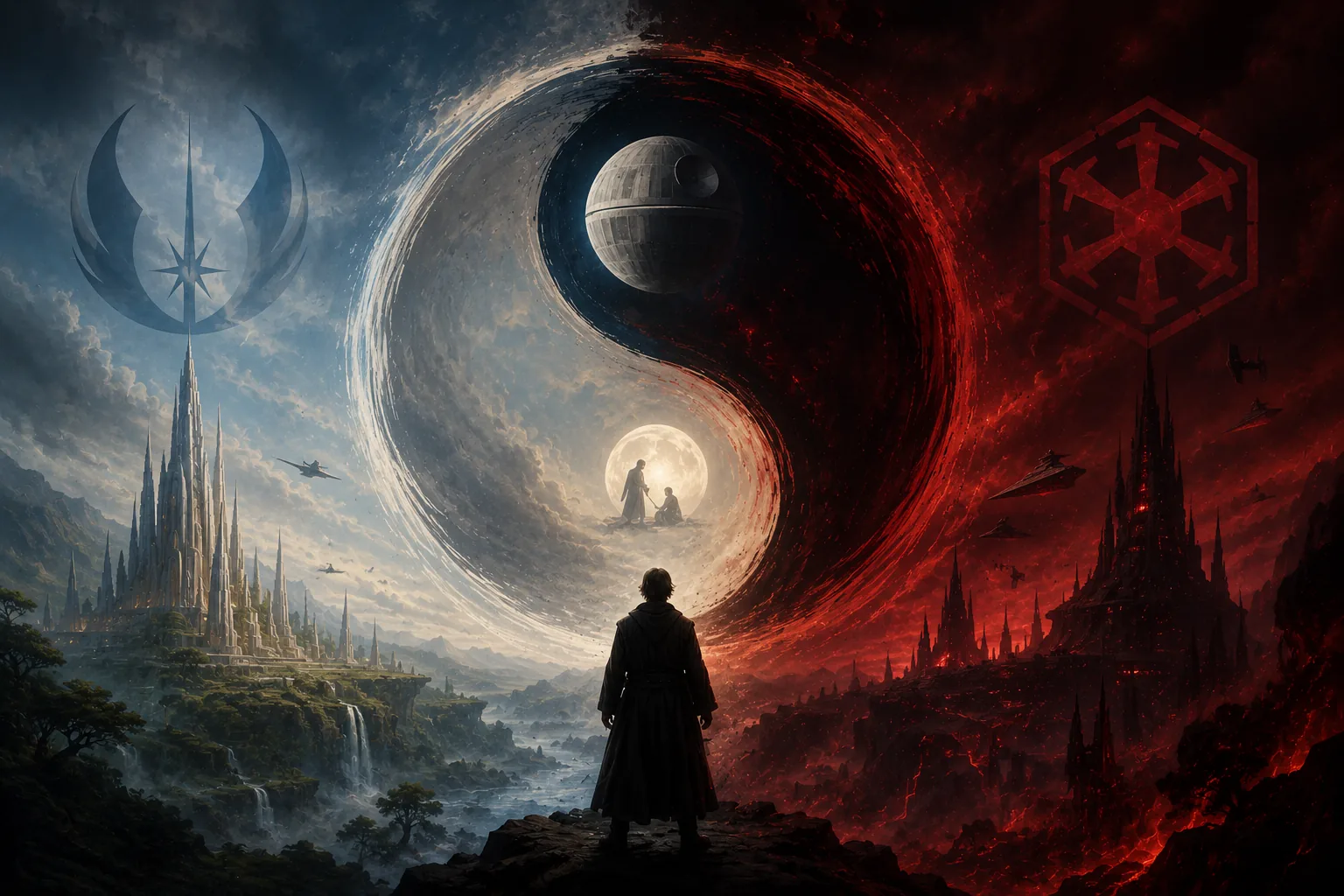
Qui-Gon Jinn says something in The Phantom Menace that most people gloss over. He tells the Jedi Council that Anakin Skywalker was conceived by the midi-chlorians, that the boy is the fulfillment of a prophecy about bringing balance to the Force. The Council hears this and nods gravely. But nobody in that room stops to ask the obvious question: balance to what?
At the time of Anakin's birth, there are roughly ten thousand Jedi Knights operating across the galaxy. The Sith number exactly two. If the Force wanted balance, and if Anakin was the instrument of that balance, then the math is not complicated. And it is not in the Jedi's favor.
This is where the standard reading of Star Wars falls apart. The franchise is sold as a story about good triumphing over evil, light banishing darkness. But if you track the actual behavior of the Force across all nine saga films, a different pattern emerges. The Force does not pick sides. It picks corrections. And every correction looks like demolition.
The Prophecy Nobody Wanted to Read Correctly
The Chosen One prophecy is referenced repeatedly across the prequel trilogy, and it is consistently misinterpreted by the characters who cite it. The Jedi assume that "balance" means the elimination of the dark side. This is self-serving reasoning. A scale with weight on only one side is not balanced. It is tilted.
Qui-Gon is the only Jedi who seems to understand this on some level. He operates outside the Council's authority, follows the living Force rather than institutional doctrine, and insists on training Anakin despite the Council's fear. He does not promise that Anakin will serve the Jedi. He says the boy will fulfill the prophecy. Those are not the same thing.
Mace Windu and Yoda both express doubt about Anakin, and the films frame that doubt as wisdom. But look at what actually happens. Anakin does bring balance to the Force. <spoiler>He destroys the Jedi Order, reducing the light side to a handful of survivors. Then, decades later, he destroys the Sith by killing the Emperor.</spoiler> The prophecy was accurate. The Jedi just assumed they would survive its fulfillment.
The Force generated Anakin not to serve the Jedi but to demolish them. He was a correction, not a champion.
Destruction as the Force's Primary Tool
Track the pattern across the saga. Every time one side of the Force accumulates too much institutional power, a figure emerges who dismantles it.
Phase One: The Jedi Overcorrection. By the time of the prequels, the Jedi Order has become a political institution. They serve as generals, diplomats, and enforcers of a Republic that is visibly rotting from within. They have codified the Force into dogma, forbidden attachment, built a massive temple on the political capital of the galaxy, and recruited children. They have not eradicated the dark side. They have simply monopolized access to the Force and called it peace.
The Force's response: Anakin Skywalker. A vergence in the Force, born without a father, strong enough to break the entire system. His fall is typically framed as a tragedy of personal weakness. But from the Force's perspective, it looks like a controlled demolition. The Jedi Order was bloated, rigid, and blind. Palpatine exploited that blindness, yes. But the Force provided the detonator.
Phase Two: The Sith Overcorrection. The Empire rises. For roughly twenty years, the dark side dominates the galaxy through totalitarian control. Two Sith and a military apparatus enforce obedience through fear. The Force is suppressed, perverted, weaponized.
The Force's response: Luke Skywalker. Another Skywalker, hidden at birth, raised outside the system, trained just enough to be dangerous. <spoiler>Luke does not defeat the Empire through superior combat skill. He defeats it by reaching the part of Anakin that still exists inside Vader. He triggers the original correction's final act: Anakin kills Palpatine, destroying the Sith.</spoiler>
Luke is not the new champion of the Jedi. He is the catalyst that completes the first correction and begins the reset.
Phase Three: The Remnant Problem. The sequel trilogy is polarizing for many reasons, but it fits the pattern. <spoiler>The First Order is a Sith-adjacent remnant that has rebuilt Imperial power under Snoke and, later, a resurrected Palpatine. The Force's response is Rey, another figure of mysterious origin with immense raw power.</spoiler> She does not restore the Jedi Order. She ends the Sith lineage. The demolition continues.
Three generations. Three corrections. Each one tears down whatever has grown too powerful.
Qui-Gon Knew and the Council Didn't Want to Hear It
Qui-Gon Jinn is the most important character in the entire saga for understanding the Force's actual agenda, and he dies in the first prequel. This is not an accident in narrative terms.
Qui-Gon follows what he calls the "living Force," a distinction the films make deliberately. The Jedi Council follows the "unifying Force," which is more concerned with prophecy, destiny, and institutional continuity. Qui-Gon's version of the Force is wild, present-tense, and disinterested in preserving the Jedi as an institution. The Council's version is self-perpetuating. It reads the prophecy through a lens of survival.
Consider the Council scene in The Phantom Menace carefully. Qui-Gon presents evidence that the Sith have returned and that the Chosen One has appeared. The Council's response is not to re-examine their assumptions. It is to dig in. They refuse to train Anakin. They doubt the Sith's return. They do exactly what a rigid institution does when confronted with existential information: they reject it.
Qui-Gon dies before he can train Anakin, and the boy is instead raised by Obi-Wan, a deeply loyal Jedi who follows the Code. This matters. Anakin's corruption is not just Palpatine's doing. It is also the result of being shaped by an institution that could not accommodate what he was. The Jedi told a boy born of the Force itself that his emotions were weakness, that attachment was forbidden, that his visions of his mother's suffering should be suppressed.
The Force created a being of unparalleled power and the Jedi tried to sand down every edge that made him dangerous. The result was predictable. The institution broke the instrument, and the instrument broke the institution.
After death, Qui-Gon becomes the first Jedi to achieve Force consciousness, teaching Yoda and eventually Obi-Wan. The film frames this as spiritual achievement. But it also reads as the Force preserving the one Jedi who understood its true nature, ensuring his perspective survived the purge.
The Skywalker Bloodline as a Recurring Demolition Crew
The Skywalker family is not a dynasty of heroes. It is a lineage of demolition instruments, each one calibrated to destroy whatever has grown out of balance.
Anakin destroys the Jedi Order (too much light-side institutional power) and, eventually, the Sith (too much dark-side institutional power). He is the wrecking ball that swings both directions.
Luke could have rebuilt the Jedi into another institution. Instead, <spoiler>by the time of the sequel trilogy, his attempt at a new Jedi academy has failed. He has retreated to exile on Ahch-To, and the ancient Jedi texts are stored in a tree that Yoda's ghost burns down.</spoiler> Yoda laughs while doing it. The Force, through its dead agents, is actively preventing the Jedi from re-institutionalizing.
Luke's final act in The Last Jedi is instructive. He does not fight Kylo Ren with a lightsaber. He projects an illusion across the galaxy, buys time for the Resistance to escape, and then becomes one with the Force. His last act is sacrificial misdirection, not conquest. He does not defeat the enemy. He ensures survival long enough for the next correction to arrive.
Rey ends the Palpatine bloodline and, with it, the last organized expression of Sith power. She takes the Skywalker name at the end of The Rise of Skywalker, but she does not rebuild the Order. There is no graduation ceremony. No new younglings lining up for selection. The saga ends with a single Force user standing in a desert, alone. No temple. No council. No institution. Just a woman with two buried lightsabers and an empty horizon.
The Force has spent nine films systematically preventing either side from building a permanent power structure.
The Midi-chlorian Detail Everyone Ignores
The Phantom Menace introduces midi-chlorians, and the fan response was hostile enough that the concept was largely abandoned in subsequent films. But the midi-chlorian explanation is actually the most revealing piece of Force mythology in the saga.
Qui-Gon explains that midi-chlorians are microscopic life forms that reside within all living cells, and that they communicate the will of the Force. The key word is "will." The Force has intent. It is not a passive energy field. It is not a tool that users wield. It has preferences, and it acts on them.
Anakin's conception by the midi-chlorians is the starkest expression of this. The Force did not wait for a Jedi and a Sith to produce a powerful child through natural means. It manufactured one. It intervened directly in biological reproduction to create the instrument it needed.
This is not the behavior of a neutral energy field. This is the behavior of an ecosystem regulating itself. When a forest grows too dense, fire clears the undergrowth. When a predator population crashes, prey species explode and strip the environment bare. The Force operates on the same principle. It does not care about the Jedi. It does not care about the Sith. It cares about the system.
There is a secondary reading here that is darker. Palpatine suggests in Revenge of the Sith that his master, Darth Plagueis, learned to manipulate midi-chlorians to create life. The implication, left deliberately ambiguous, is that Palpatine or Plagueis may have been responsible for Anakin's conception. If true, the irony is staggering. The Sith's attempt to manipulate the Force produced the instrument of their own destruction. Even when the dark side tries to game the system, the Force redirects the result toward balance.
The Case Against
The strongest argument against this reading is intentionality. George Lucas has stated in interviews that the Force is fundamentally about good and evil, that the dark side is a cancer, and that balance means the elimination of the Sith. If the creator says balance means the light side wins, who are we to argue?
Three problems with that objection.
First, the text contradicts the author. The films show a Force that generates Anakin to destroy ten thousand Jedi. If balance meant "the light side wins," then the Chosen One prophecy makes no sense. Why would the Force create a being to destroy its own champions? Lucas can say balance means whatever he wants, but the narrative he built tells a different story.
Second, the idea that the dark side is a "cancer" on the Force is a Jedi teaching, not an established fact within the fiction. The Jedi are not objective observers of the Force. They are participants with institutional interests. Their theology serves their power structure. Treating Jedi doctrine as objective truth is like treating a corporation's mission statement as investigative journalism.
Third, the expanded material, including The Clone Wars and Rebels, both of which Lucas was heavily involved in, introduces Force entities like the Father, the Son, and the Daughter on Mortis. These beings explicitly represent balance, light, and dark as co-equal forces. The Mortis arc depicts the dark side not as a corruption but as a necessary component of a balanced system. When the Son (dark) or the Daughter (light) dies, the system collapses. Balance requires both.
Another counterargument: maybe the Force is just bad at its job. Maybe the constant oscillation between Jedi dominance and Sith dominance is not deliberate correction but failure. The Force keeps trying to establish peace and keeps getting it wrong.
This is possible, but it requires ignoring the precision of the pattern. The Force does not generate random powerful beings scattered across the galaxy. It generates Skywalkers, calibrated to the specific imbalance of their era, placed in proximity to the exact institutions that need dismantling. Anakin is delivered to the Jedi doorstep. Luke is hidden on Vader's home planet. That level of specificity and narrative economy suggests design, not incompetence.
The Verdict
Star Wars is not a story about good defeating evil. It is a story about a living system that refuses to let any faction hold power indefinitely. The Jedi are not the heroes of the Force. The Sith are not its villains. Both are expressions of a larger dynamic, and both get demolished when they overreach.
The Force chose Anakin not because the galaxy needed a savior but because it needed a reset. It chose Luke not because the Rebellion was righteous but because the Empire had tipped the scale too far. It chose Rey not because the light side deserved to win but because the dark side had once again accumulated too much concentrated power.
The pattern is not good versus evil. It is accumulation versus correction. Every time one side builds a temple, a council, an empire, or a fleet, the Force sends someone to tear it down. The Skywalker saga is not a hero's journey. It is an ecosystem documentary, filmed with lightsabers.
Qui-Gon tried to tell them. Nobody listened. The Council was too busy preserving its own relevance to hear what the living Force was actually saying. And the Force did not care whether they listened or not. It had already made its correction. It was just waiting for delivery.