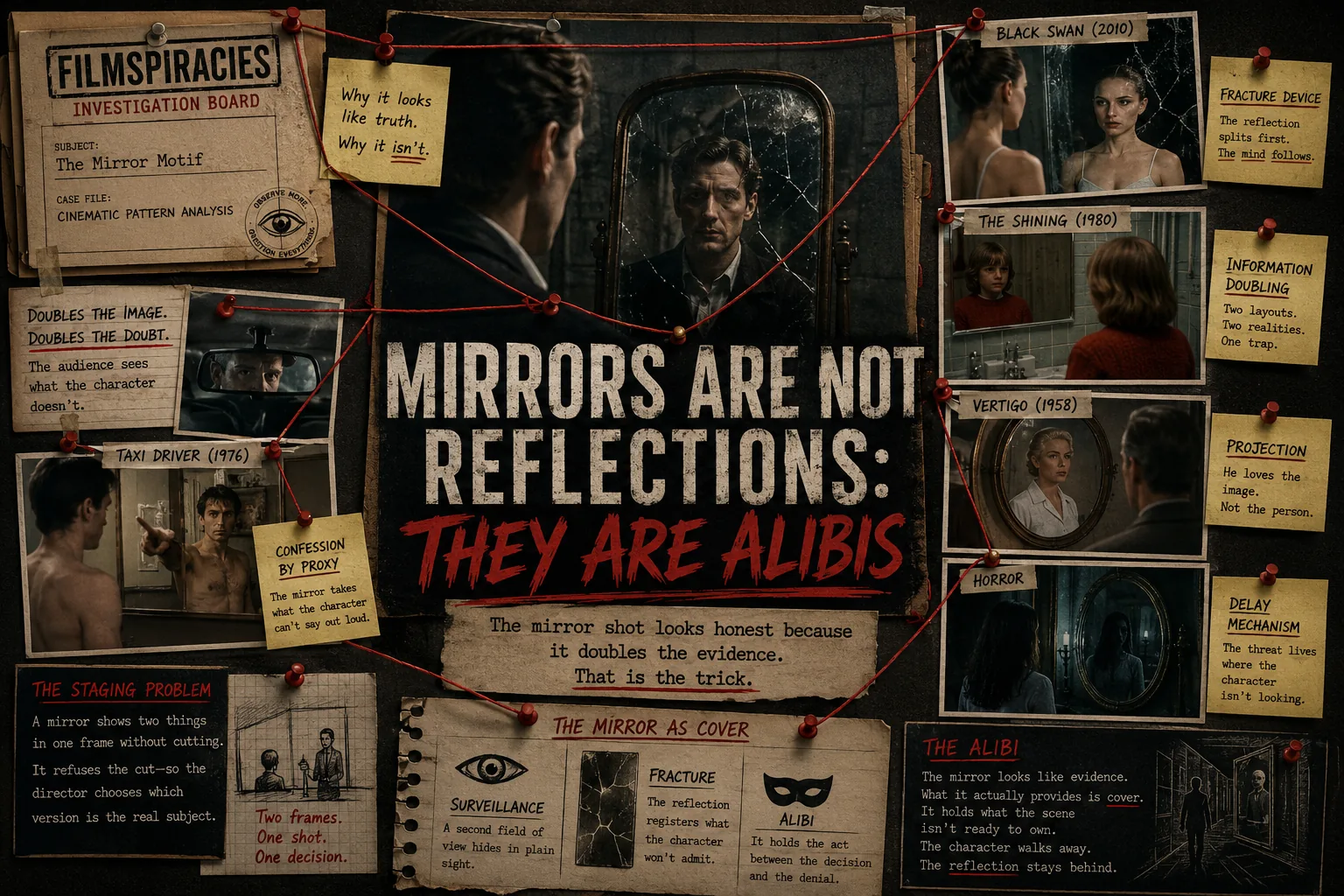
Mirrors Are Not Reflections: They Are Alibis
The mirror shot looks honest because it doubles the evidence. That is the trick.
A character steps in front of a mirror and the audience gets two of them: one acting, one watching. It reads as disclosure. Cinema has trained viewers to expect that a mirror means a revelation is coming: identity fracture, hidden motive, a second self about to contradict the first. But watch the scene again. The mirror does not reveal. It provides cover.
01 / The Scene's Plausible Deniability
When a film shows a character through their reflection instead of head-on, something shifts in the evidence chain. The image is technically accurate, there they are twice, but the camera is no longer directly responsible for what it shows. The mirror takes the accusation.
This matters when a film needs to show something without committing to it. A character who cannot yet admit fear, guilt, or desire is safer shown in a mirror. The reflection can carry what the body refuses. If the audience projects meaning onto it, the film has not lied. It simply framed the shot.
02 / The Mirror as Cover
Mirrors let a film show the emotional state it cannot yet show directly. The pattern works across several kinds of hidden information.
Surveillance. A mirror positioned behind a character lets the scene contain a second field of view. Someone or something can occupy that reflected space while the foreground character remains unaware. The audience is in on it. The character is not. The mirror is the camera's informant.
Fracture. When a character is in psychological conflict, a mirror doubles them at the exact moment when doubling is most loaded. The composition does not need to state that this person is coming apart. Two frames of the same face do the work. The film can maintain surface coherence while the reflection registers the pressure.
Confession by proxy. A character who is about to do something irreversible may stop in front of a mirror. One reading of that beat: a last moment of self-recognition before the decision lands. Another reading: the mirror absorbs the act before it happens, so the rest of the scene can proceed as if the character's hands were clean.
03 / The Staging Problem
A mirror solves a specific staging problem: how to show two things in one frame without cutting.
The cut is the most honest editorial gesture in film. It acknowledges that the story is moving, that time has passed, that perspective has shifted. A mirror refuses the cut. It holds both images simultaneously, the character and the character watching themselves, and the director decides which version is the real subject of the shot.
This is not neutral. When a director frames a character in a mirror rather than directly, they are choosing the version who is watching over the version who is acting. The watcher carries more ambiguity. The watcher could be noticing something the actor is not. The audience is invited to read the reflected face as the truer one, even though both faces are the same person.
04 / How Different Genres Use It
The mirror motif adapts to each genre's central anxiety.
Horror uses mirrors as delay mechanisms. The threat in a horror mirror is almost always in the part of the frame the character is not looking at. The character stares at their own reflection; the audience scans the background. The mirror promises a reveal that has not arrived yet. When it does arrive, the figure behind the character or the face that should not be there, the mirror is what made the audience wait for it. The reflection was holding the room hostage.
Noir and thriller use mirrors for surveillance and the doubling of identity. A useful pattern to trace: protagonists in noir tend to be positioned near mirrors during scenes of moral compromise rather than scenes of virtue. One interpretation is that the mirror is the film keeping a record. Here is who you are when no one is looking, except someone is always looking, because the mirror is always there. The reflected face is evidence. Whether the protagonist registers it as such is the point.
Melodrama and character drama use mirrors for self-interrogation. A character alone with a mirror, in a drama, is a character being forced to have the conversation they have been avoiding with everyone else. The mirror does not respond. That is the cruelty of the device in this context. The reflection has no new information to offer. The character is arguing with themselves, and the film is patient enough to let them lose.
05 / Where the Pattern Shows Up
A few recurring examples, read as interpretive cases rather than production fact:
In Black Swan, mirrors function as fracture devices from the first act. The protagonist's reflection begins to behave on a slight delay, a detail the film introduces carefully and then escalates. By the time the divergence becomes explicit, the audience has already been trained to distrust the reflected image. The mirrors in that film are not where truth lives. They are where the performance lives.
In Taxi Driver, the mirror address, the protagonist rehearsing a confrontation alone in his room, is staged as an audition for violence that has not yet found an external target. The mirror provides the audience for the performance before a real audience exists. Reading the scene this way, the mirror is not a symbol of self-awareness. It is the device that lets the character externalize a threat without yet committing to a direction for it.
In The Shining, mirrors appear throughout as information-doubling devices. The Overlook's geometry surfaces in reflections in ways that suggest the building has a second layout running parallel to the visible one. The hedge maze at the film's close functions as the most explicit version of this: a space where position and reflection become indistinguishable, and where the person doing the tracking and the person being tracked converge.
Vertigo frames its mirror logic around projection. Scottie is not drawn to a person; he is drawn to an image of a person he has already constructed. Mirrors and reflective surfaces in the film tend to appear when the constructed version and the actual person share the same frame, holding both visible simultaneously rather than resolving them into one, which is precisely what Scottie cannot do.
06 / The Alibi
The mirror is the scene's alibi.
When a film needs a character to carry guilt, the guilt of knowing, of wanting, of planning, but cannot yet let them confess it, the mirror is where that guilt lives between the act and the acknowledgment. The camera shows the reflection. The audience reads the face. The film maintains distance.
The mirror looks like evidence. What it actually provides is cover. It lets the scene contain information it is not ready to commit to directly. The character walks away. The film moves forward. The reflection stays behind in the glass, holding what was in the room.
That is the function of the mirror shot. Not revelation. Deniability.
